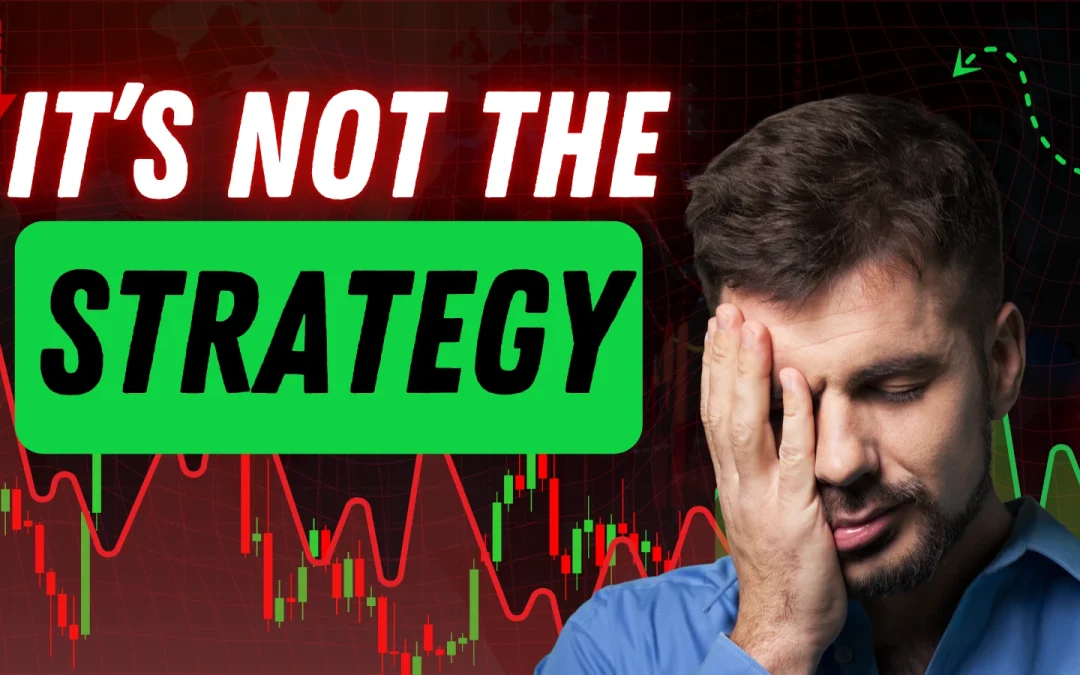
Why Most Traders Lose (And It’s Not the Strategy)
Ask ten traders why most people lose money in the markets, and you’ll usually hear the same answer: bad strategies. But the truth is far less comforting — and far more important.
Most traders don’t fail because their strategy is broken. They fail because of how they manage risk, handle losses, and behave under pressure. This article breaks down the real reasons traders lose, and why improving execution and discipline matters more than finding the “perfect” setup.
Table of Contents
- The myth of the perfect strategy
- Risk management is the real problem
- How emotions sabotage traders
- Overtrading: the silent account killer
- Why expectancy beats win rate
- What actually helps traders improve
- Frequently Asked Questions
The myth of the perfect strategy
Most traders spend years jumping from one system to the next, convinced that the right indicator, algorithm, or setup will finally make everything click.
The uncomfortable truth is this: many strategies work — at least some of the time. Even simple approaches can be profitable when applied consistently with proper risk control.
What breaks traders isn’t the strategy itself, but what happens when the strategy starts losing.
Risk management is the real problem
The fastest way to blow an account is not a bad entry — it’s risking too much on a single trade.
When traders:
- Increase position size to “make it back”
- Ignore stop-loss rules
- Risk more after a win
They turn normal drawdowns into catastrophic losses. This is why many traders with decent win rates still end up losing money over time.
Survival matters more than profits. Without it, no strategy can succeed.
How emotions sabotage traders
Markets trigger strong emotional responses:
- Fear after losses
- Greed after wins
- Frustration during chop
These emotions lead to predictable mistakes — moving stop-losses, closing winners early, or entering trades that don’t meet the plan.
Most traders know what they should do. They just struggle to do it consistently when real money is on the line.
This is why emotional control is not a “soft skill” in trading — it’s a core competency.
Overtrading: the silent account killer
Another major reason traders lose is overtrading.
Overtrading often comes from:
- Boredom
- Fear of missing out (FOMO)
- The desire to recover losses quickly
More trades do not mean more opportunity. In fact, they usually mean more fees, more mistakes, and more emotional fatigue.
Many profitable traders take far fewer trades than beginners expect — and they’re selective for a reason.
Why expectancy matters more than win rate
One of the biggest misconceptions in trading is that a high win rate guarantees success.
In reality, profitability depends on expectancy — the relationship between:
- Average win size
- Average loss size
- Win rate
A trader can win 70% of the time and still lose money if losses are large and uncontrolled. Meanwhile, another trader can be profitable with a lower win rate by keeping losses small and letting winners run.
This is why risk control and consistency matter more than finding a “high accuracy” strategy.
What actually helps traders improve
If strategy hopping isn’t the answer, what is?
- Consistent risk management (such as the 1% rule)
- A repeatable trading plan
- Fewer, higher-quality trades
- Emotional discipline during drawdowns
Progress in trading usually looks boring from the outside. It’s built through repetition, patience, and restraint — not constant reinvention.
Frequently Asked Questions
Do most traders really lose money?
Yes. Studies and broker data consistently show that a majority of retail traders lose money over time, mainly due to poor risk management and emotional decision-making.
Is it possible to be profitable with a simple strategy?
Yes. Many profitable traders use simple strategies, but they apply them with discipline, proper risk control, and consistency.
What is the biggest mistake new traders make?
Risking too much per trade and trying to recover losses quickly. Both behaviors dramatically increase the risk of account blowups.
Should I change my strategy if I’m losing?
Before changing strategies, evaluate execution, risk sizing, and emotional discipline. Many losses come from how a strategy is traded, not the strategy itself.
Final takeaway
Most traders don’t lose because they chose the wrong indicator or setup. They lose because they underestimate the importance of risk control, emotional discipline, and consistency.
Improving as a trader often means doing less — fewer trades, smaller risk, and more patience. The traders who survive long enough to learn are the ones who eventually succeed.
You can embed your YouTube video here to reinforce the key ideas and improve engagement.