Stochastic Oscillator: How to Use It for Gold Scalping (XAU/USD)
If you scalp gold (XAU/USD), you already know one thing: price can move fast, reverse sharply, and fake you out right when you think you’re right. The Stochastic Oscillator is a simple momentum tool that can help you spot exhaustion, pullbacks, and potential reversals — especially when gold is choppy or mean-reverting.
This guide explains how Stoch works, the best settings for gold scalping, and a few practical entry/exit frameworks that keep things simple.
Table of Contents
- What is the Stochastic Oscillator?
- Why Stoch works well for gold scalping
- Best Stoch settings for gold scalping
- Best timeframes for XAU/USD scalping
- The 4 core Stoch signals that matter
- 3 simple Stoch strategies for gold scalping
- Stops, targets, and risk rules
- Common mistakes (why Stoch fails)
- FAQs
What is the Stochastic Oscillator?
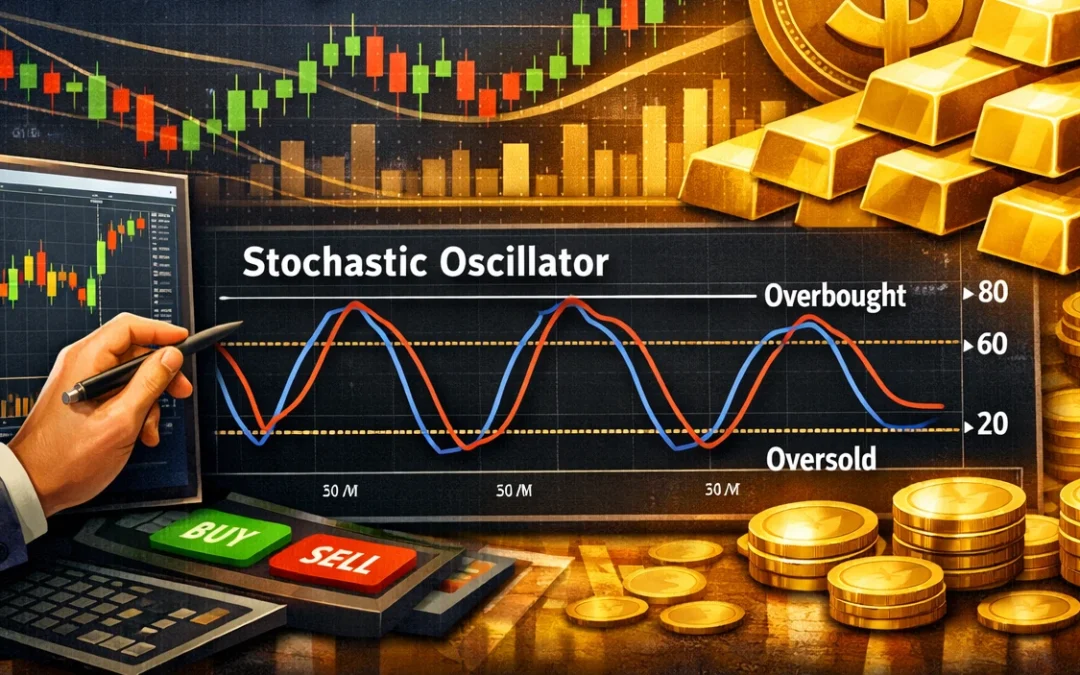
The Stochastic Oscillator (often called Stoch) measures momentum by comparing the current closing price to the recent high-low range over a set number of periods. It answers a simple question:
Is price closing near the top of the recent range (strong momentum) or near the bottom (weak momentum)?
Stoch typically uses two lines:
- %K = the faster line (reacts quickly)
- %D = the slower moving average of %K (smoother signal)
Common levels you’ll see:
- Above 80 = “overbought” (momentum stretched)
- Below 20 = “oversold” (momentum stretched)
Important: Overbought does not automatically mean “sell” and oversold does not automatically mean “buy.” In strong trends, Stoch can stay pinned near extremes.
Why Stoch works well for gold scalping
Gold often shows:
- Sharp mean reversion (snap-backs after pushes)
- Frequent liquidity grabs around round numbers
- Fast momentum shifts during high-volatility sessions
Stoch helps you see when a move is losing steam, especially when paired with a simple context filter like trend direction or a key level.
Best Stoch settings for gold scalping
There isn’t one perfect setting, but there are settings that are consistently easier to trade for scalping.
Recommended starting point (balanced)
- Stoch (14, 3, 3)
- Levels: 20 / 80
Faster scalping (more signals, more noise)
- Stoch (9, 3, 3)
- Levels: 20 / 80
Smoother signals (fewer, higher-quality trades)
- Stoch (21, 5, 5)
- Levels: 20 / 80
Simple rule: The faster the settings, the more signals you’ll get — and the more discipline you need to avoid overtrading.
Best timeframes for XAU/USD scalping
For gold scalping, these are the most practical:
- Primary execution: 1-minute to 5-minute chart (M1–M5)
- Context filter: 15-minute chart (M15) for trend and key levels
If you only use one timeframe, you’ll often take “perfect-looking” Stoch signals directly into a larger trend. A quick check of M15 helps you avoid that.
The 4 core Stoch signals that matter
1) Extreme + cross (basic reversal signal)
Buy setup: Stoch below 20 and %K crosses above %D.
Sell setup: Stoch above 80 and %K crosses below %D.
This works best in ranges or after a strong push into a key level.
2) “Re-entry” signal in a trend (higher-probability scalping)
Instead of fading the trend, use Stoch to enter on pullbacks:
- Uptrend: wait for Stoch to dip below 20 then turn back up, and take a long as price resumes the trend
- Downtrend: wait for Stoch to rise above 80 then turn down, and take a short as price resumes the trend
This is often more reliable than trying to call tops and bottoms.
3) Divergence (warning, not an entry by itself)
Divergence happens when:
- Price makes a new high, but Stoch makes a lower high (bearish divergence)
- Price makes a new low, but Stoch makes a higher low (bullish divergence)
Use divergence as a “heads up” — then wait for confirmation (like a break of a micro trendline or a structure shift).
4) Midline filter (simple momentum confirmation)
Many scalpers ignore the midline, but it’s useful:
- Above 50 = bullish momentum bias
- Below 50 = bearish momentum bias
If you only take longs when Stoch is regaining above 50 (and shorts below 50), you’ll avoid a lot of weak countertrend trades.
3 simple Stoch strategies for gold scalping
Strategy #1: Range bounce (best for choppy gold)
Best condition: Gold is ranging between clear support/resistance (often during slow hours).
- Mark range high and range low (use recent swing points)
- Wait for price to touch range edge
- Look for Stoch extreme + cross (below 20 for buys, above 80 for sells)
- Enter on confirmation candle (avoid “catching knives”)
Target: mid-range first, then opposite side if momentum holds.
Stop: just beyond the range edge / recent swing.
Strategy #2: Trend pullback entry (higher-probability)
Best condition: Gold is trending cleanly on M15.
- Identify trend on M15 (higher highs/higher lows for uptrend, opposite for downtrend)
- On M5, wait for a pullback into a prior level or moving average area (optional)
- Use Stoch to time the end of the pullback (turning up from oversold in an uptrend, turning down from overbought in a downtrend)
- Enter when price resumes direction (break of pullback micro-structure)
Target: previous swing high/low or a fixed scalp target.
Stop: below/above the pullback low/high.
Strategy #3: Divergence + structure (reversal setup)
Best condition: Gold spikes into a key level (round number, prior high/low) and starts to stall.
- Wait for divergence on M5 (don’t trade it immediately)
- Look for a structure shift (failed push, lower high after a high, or higher low after a low)
- Enter on the break of the micro trendline or structure
Target: next key level or the mean (VWAP/previous consolidation zone if you use those).
Stop: beyond the spike high/low.
Stops, targets, and risk rules (simple scalper framework)
Scalping gold without rules is how traders get chopped up. Keep it simple:
- Risk per trade: keep it small and consistent (example: 0.25%–1%)
- Stop placement: beyond the structure that would prove you wrong
- Minimum target: aim for at least 1R when possible (or scale partials)
- Trade filter: avoid taking Stoch signals into major news spikes
Quick tip: If you find yourself taking too many trades, slow your Stoch settings or require an extra filter (like trend direction on M15).
Common mistakes (why Stoch fails)
Mistake #1: Treating overbought/oversold as automatic buy/sell
In strong trends, Stoch can stay above 80 or below 20 for a long time. Fade-trading that without context can be expensive.
Mistake #2: Using Stoch alone
Stoch is a timing tool, not a full strategy. You still need a basic framework: trend, level, or range.
Mistake #3: Overtrading fast settings
Faster settings create more signals and more temptation. If you’re new, start with (14,3,3) and trade fewer, cleaner setups.
Mistake #4: Ignoring session and volatility
Gold behaves very differently depending on the session. When volatility spikes, signals will require wider stops and tighter discipline.
Frequently Asked Questions
Is the Stochastic Oscillator good for gold scalping?
Yes — it can be very useful for timing pullbacks and spotting momentum exhaustion in XAU/USD, especially when paired with a trend or range framework.
What is the best Stochastic setting for gold scalping?
A strong starting point is (14, 3, 3). If you want more signals, try (9, 3, 3). If you want fewer, smoother signals, try (21, 5, 5).
Should I buy when Stoch is below 20 and sell when above 80?
Not automatically. In strong trends, Stoch can stay extreme. Use extremes as a context clue and wait for confirmation (cross + structure + trend filter).
Which timeframe is best for using Stoch on XAU/USD?
Many scalpers use M1–M5 for entries and M15 for trend context. This reduces countertrend signals and improves trade selection.
What’s the simplest way to use Stoch for scalping?
Use it as a pullback timer in the direction of the trend: in an uptrend, wait for Stoch to dip and turn up; in a downtrend, wait for Stoch to rise and turn down.
Final takeaway
The Stochastic Oscillator can be a powerful tool for gold scalping when you use it for what it’s best at: timing. Keep your approach simple: trade with the trend or within a clear range, wait for confirmation, and manage risk like a pro. That’s how Stoch becomes a consistent helper instead of a noisy distraction.